



The United States now accounts for the largest share of the world’s Bitcoin mining. Chinese authorities banned the activity earlier this year causing miners to shut down operations and move overseas.
China’s share of the power of computers connected to the global Bitcoin network, known as the “hash rate,” fell to zero by July. That’s a sharp drop from 44% in May, according to data published Wednesday by the UK’s Cambridge Centre for Alternative Finance. In 2019, the country accounted for three-quarters of the global hash rate.
The data shows that the U.S. now accounts for 35.4% of global Bitcoin mining power (hash rate) as of the end of August.
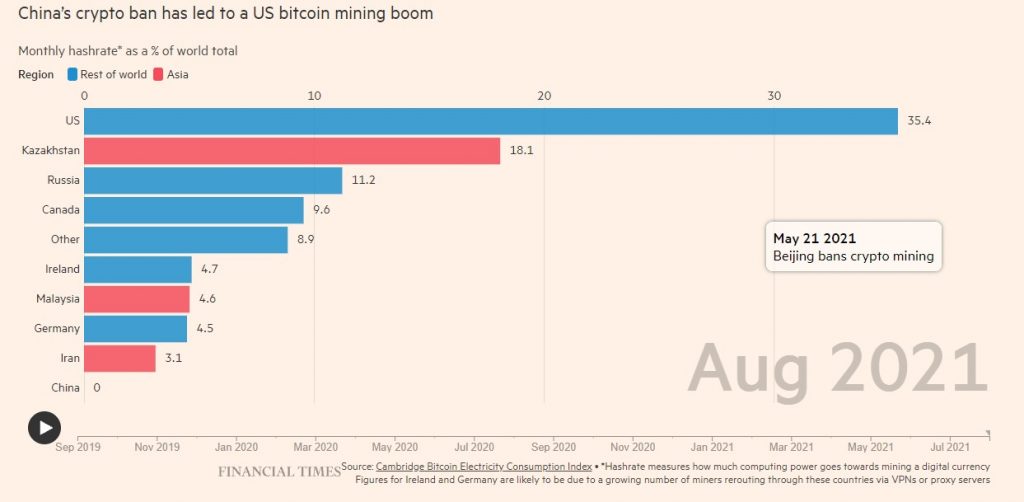
The U.S. share of the global hash rate increased from 17% in April to 35% in August, while Kazakhstan rose to 18% in the same period.
In May, China’s State Council banned cryptocurrency mining and trading, citing environmental and financial concerns. The decision prompted an exodus of miners in search of cheap energy and crypto-friendly politicians in other countries.
Beijing has since gone further, labeling all crypto-related activities “illegal” last month, extending its prohibition to include foreign operators.
A new home in the U.S.
The U.S. is now the top destination for Bitcoin miners in search of a new home for their activity and it’s not hard to see why.
States like Texas have some of the world’s lowest energy prices, making it a major incentive to miners where their only variable cost is typically energy.
What’s more, much of the United States also boasts of renewable power sources.
New York produces more hydroelectric power than any other state in the eastern part of the Rocky Mountains and is on a mission to produce 100% carbon-free electricity. Washington has also become a mecca for hydropowered mining farms in the U.S. Texas’ share of renewable energy is on the rise, with 20% of its power coming from the wind as of 2019. The Texas grid is also adding more wind and solar power to its plants.

Across the United States, miners are also harnessing nuclear power and taking advantage of natural gas going to waste in oil fields across Texas. Their use of natural gas reduces greenhouse gas emissions and generates money for the gas providers and miners.
America’s shift towards clean energy sources is an indication that Bitcoin might not be bad for the environment after all.
Join our Trading Community and learn how to trade Forex like a pro!
Some U.S. states like Texas also have crypto-friendly policymakers and an adequate supply of hosting infrastructure: the state allows customers to choose between power providers and its political leaders are pro-crypto. All these are dream conditions for miners, making the U.S. the ideal destination for them.
Not all miners are headed to renewable destinations
Kazakhstan and Russia are behind the U.S. in terms of their share of the global Bitcoin mining market.
Kazakhstan, which neighbors China, is home to coal mines that provide a cheap and abundant supply of energy and accounts for 18.1% of all crypto mining. The Kazakh government has blamed exiled crypto hunters for the recent energy shortages, passing a cryptocurrency mining tax that will come into effect in 2022.