

Forex trading in Algeria is one of the most complex parts of the African forex market. While many African countries are opening up to online trading, Algeria remains cautious. The government’s strict control over foreign currency, limited broker access, and underground trading networks make forex trading in Algeria both challenging and fascinating. Despite the restrictions, many Algerians are finding creative ways to participate in the global forex market.
Understanding Forex Trading in Algeria
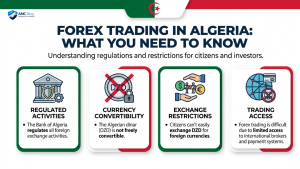
It means buying and selling foreign currencies through online platforms. However, unlike other parts of the African forex market, Algeria’s financial system is tightly controlled by the government. The Bank of Algeria regulates all foreign exchange activities. The Algerian dinar (DZD) is not freely convertible, meaning citizens can’t easily exchange it for foreign currencies. This makes forex trading difficult in Algeria because traders need access to international brokers and payment systems that operate in foreign currencies like USD or EUR.
Government Control and Regulation
The Algerian government maintains strict control over currency exchange to protect the national economy. The Bank of Algeria and the Ministry of Finance oversee all foreign transactions, and online forex trading is not officially recognized or regulated. This doesn’t mean forex trading in Algeria is completely illegal, but it operates in a gray area. Traders who want to participate in the global forex market often have to find alternative routes, sometimes through offshore brokers or underground trading networks. The government’s main concern is preventing capital flight and money laundering. However, this tight control also limits financial innovation and makes it harder for ordinary citizens to access global markets.
Broker Accessibility in Algeria
Their accessibility in Algeria is very limited. Most international forex brokers do not operate directly in the country because of regulatory restrictions. Local traders often rely on offshore brokers that accept Algerian clients. These brokers usually allow deposits through cryptocurrency, e-wallets, or peer-to-peer (P2P) systems. However, this comes with risks such as lack of legal protection, withdrawal delays, and potential scams. Some traders use VPNs to access trading platforms that are blocked locally. Others join online communities where they share broker recommendations and trading tips. This underground network has become a lifeline for many Algerian forex traders.
Payment and Withdrawal Systems
These are one of the challenges for forex traders in Algeria. Because of currency restrictions, it’s difficult to use international payment methods like PayPal, Skrill, or bank transfers. Most traders use cryptocurrency as a workaround. Bitcoin, USDT, and other digital currencies have become popular tools for funding trading accounts and withdrawing profits. Some traders also use P2P exchanges to convert crypto into local currency. While these methods are not officially supported, they have made forex trading in Algeria possible for many people.
Local Trader Experiences
To understand forex trading in Algeria, it helps to hear from local traders themselves.
Yacine, a 30-year-old trader from Algiers, says he started trading forex after learning about it on YouTube. “At first, I didn’t even know how to deposit money,” he says. “Then I discovered crypto wallets, and that changed everything.”
Another trader, Samira, explains that she trades quietly to avoid attention. “It’s not easy,” she says. “You can’t talk about it openly because people think it’s illegal. But for me, it’s a way to earn in dollars and support my family.” These stories show the resilience of Algerian traders. Even with restrictions, they find ways to learn, trade, and grow.
The Government and Regulatory Stance
The Algerian government’s stance on forex trading remains conservative. The Bank of Algeria discourages citizens from engaging in unregulated online trading. However, there’s growing awareness that many young people are already trading through offshore platforms. If the government introduces clear regulations in the future, it could create safer conditions for traders and attract legitimate brokers to the country. For now, forex trading in Algeria continues to operate quietly, outside the formal financial system.
The Evolution of Forex Trading in Algeria
Forex trading in Algeria depends on how the government balances control with modernization. As more Algerians gain access to the internet and digital finance tools, the demand for forex trading will continue to grow. If regulations become clearer and payment systems improve, Algeria could become a strong player in the North African forex market. The country has a young tech-savvy population that’s eager to learn and earn globally.
Summary: Forex trading in Algeria sits between regulation and restriction. Government control, limited broker access, and underground trading networks make it a tough environment. Yet the determination of local traders shows that the desire to connect with the global forex market is stronger than any barrier. The African forex market is evolving, and Algeria is part of that story. With time, better policies, and more openness, forex trading in Algeria could move from the shadows into the spotlight.
Subscribe to our blog for more trading insights, expert analysis, market updates and strategies – join our telegram community today!