
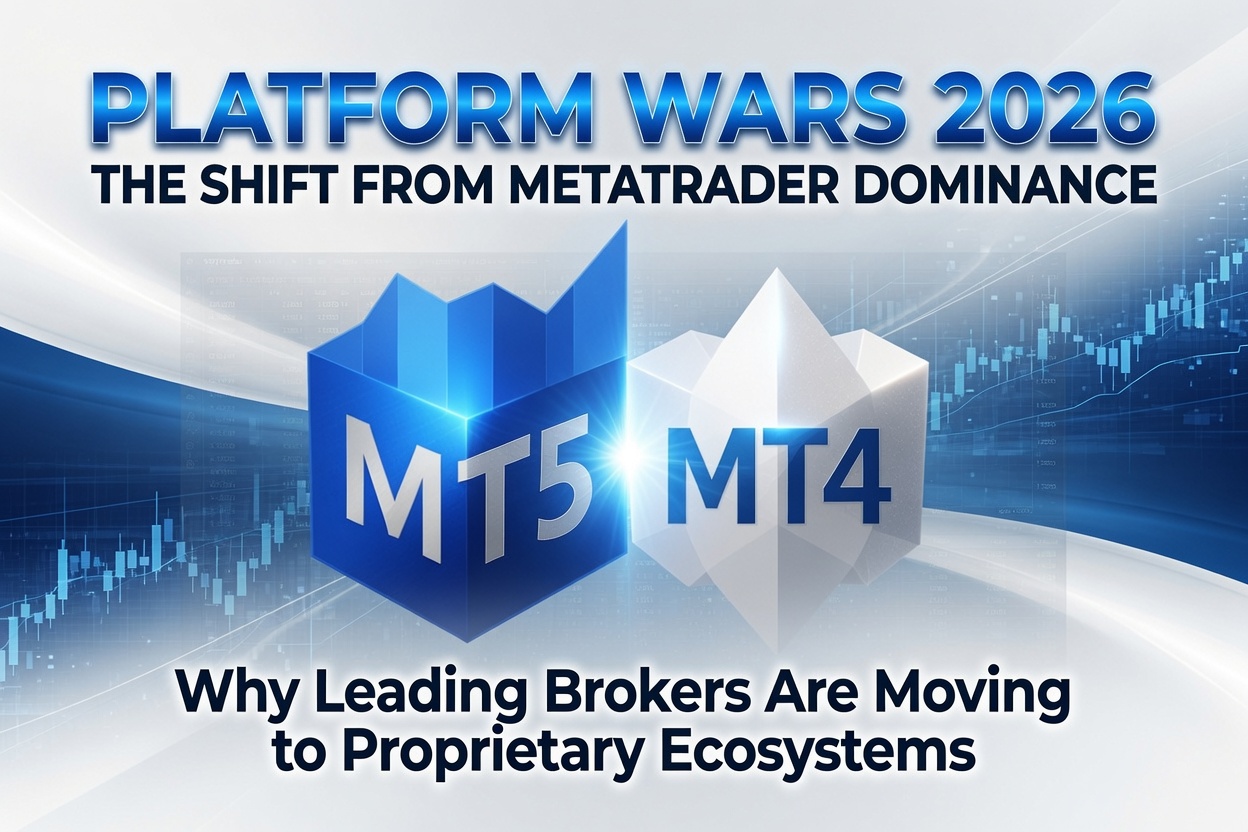

For nearly two decades, MetaTrader 4 and later MetaTrader 5 defined the retail forex experience. Brokers licensed the software, traders downloaded the familiar desktop terminal, and a massive ecosystem of Expert Advisors, indicators, and signal services grew around it. That model is now under pressure.
In 2026, major brokers are actively restricting MetaTrader access, limiting available instruments on MT platforms, and steering clients toward their own proprietary systems. This is not a quiet technical upgrade. It is a strategic realignment driven by control over data, the ability to embed AI natively, broader multi-asset offerings, and tighter regulatory compliance.
The shift is reshaping how retail clients trade and how introducing brokers (IBs) and affiliates evaluate partnerships.
Why MetaTrader Dominance Is Eroding
MetaQuotes built an extraordinarily successful product. MT4 became the default because it was reliable, relatively open, and easy for brokers to white-label. The MQL language enabled a huge third-party developer community. For years this created network effects that were hard to challenge.
Several developments exposed the risks of depending on a single external vendor:
- MetaQuotes stopped issuing new MT4 licenses years ago. Existing licences continue, but the platform is in maintenance mode with no meaningful new development.
- The 2022 temporary removal of MetaTrader apps from the Apple App Store highlighted distribution vulnerability.
- The 2024 crackdown on prop firms serving U.S. clients using MetaTrader infrastructure caused widespread disruption. Brokers and firms running proprietary or alternative platforms were far less affected.
- Security and compliance expectations have risen. Older codebases require more effort and cost to keep current.
At the same time, brokers themselves have matured. Larger firms now possess the engineering resources and client volume to justify building and maintaining their own platforms. Ownership delivers advantages a licensed terminal cannot match.
What Proprietary Platforms Actually Deliver
When a broker controls the platform, several strategic benefits follow.
Data ownership becomes complete. Every click, order, position, deposit pattern, and support interaction stays inside the broker’s systems. This data powers better risk management, more accurate client lifetime value models, and personalized product features. On a third-party platform, much of that behavioural signal is harder or impossible to capture cleanly.
Native AI integration is simpler and more powerful. Proprietary systems can embed analytics, trade ideas, risk warnings, and even agent-style assistants without relying on external APIs or workarounds. In 2026, brokers are experimenting with Model Context Protocol (MCP) connections that let external AI tools read account data or, in some cases, execute under strict controls. Doing this inside a closed ecosystem is cleaner from both a technical and compliance perspective. Start Trading with Lirunex

Trading with ECN
Multi-asset coverage expands dramatically. Many proprietary platforms offer thousands of instruments—indices, stocks, commodities, and more—while MetaTrader builds at the same broker are often restricted to a much smaller set. IG, for example, has long limited MetaTrader to a fraction of the markets available on its main platform.
Compliance and operational control improve. Regulators increasingly expect brokers to demonstrate oversight of client activity, marketing, and risk. Owning the front end makes audit trails, product gating by jurisdiction, and real-time monitoring more straightforward.
Brand differentiation finally becomes possible. When every broker offers essentially the same MetaTrader interface, competition collapses to spreads and bonuses. A distinctive proprietary experience lets brokers compete on usability, research integration, and unique tools.
How Leading Brokers Are Positioning
The movement is visible among established names, though approaches differ:
Smaller brokers unable to fund full in-house builds are turning to modern white-label alternatives such as Match-Trader or DXtrade rather than remaining solely dependent on MetaQuotes.
The optimal choice depends on the trader’s profile. Pure algorithmic traders with heavy EA reliance may still prioritise brokers that keep robust MetaTrader support. Multi-asset discretionary traders, those interested in AI-assisted workflows, or clients seeking the widest product range will often find proprietary platforms superior in 2026.
Impact on Copy Trading and Signal Ecosystems
This shift has particular consequences for social and copy trading.
On MetaTrader, copy trading and signal following frequently relied on external services or the platform’s own limited social features. Proprietary systems allow brokers to design tighter, more transparent, and better-risk-managed copy products. Performance data, risk metrics, and allocation controls can live natively inside the same environment where the trades execute.
For signal providers and strategy managers, the landscape becomes more fragmented. A strategy that performed well via MetaTrader signals may need rebuilding or re-listing on each major proprietary platform. Brokers that successfully create high-quality, regulated social layers gain a stronger retention tool and a clearer value proposition for IBs who want quality rather than pure volume.
What Traders and Introducing Brokers Should Evaluate in 2026
When assessing platforms today, look beyond the brand name of the terminal:
- Instrument coverage: How many markets are available on the main platform versus any MetaTrader version offered?
- AI and automation depth: Are tools native, transparent, and controllable, or superficial marketing features?
- Data and execution quality: Can you see realistic fills, slippage statistics, and order book depth?
- Ecosystem continuity : If you rely on EAs or specific indicators, confirm long-term MetaTrader support or viable migration paths.
- Mobile and web parity: Many proprietary platforms now match or exceed desktop usability; test both.
- Regulatory and jurisdictional fit: Proprietary control often enables cleaner product restrictions by region.
- Copy and social features : Examine transparency of performance reporting, risk controls, and fee structures.
For introducing brokers, the question is strategic: Does the broker’s platform strategy create stickier, higher-quality clients, or does it still depend on the same MetaTrader volume game that every competitor can also play?
Join the Top leading Educational platform ANC Trading community
MetaTrader is not disappearing overnight. It retains a large installed base, especially among algorithmic traders, and MetaQuotes continues to develop MT5, including recent AI-related features. Yet the centre of gravity is shifting.
Brokers that treat platforms as strategic assets rather than cost centres are building defensible advantages in data, AI capability, product breadth, and compliance. Those that remain pure MetaTrader resellers face increasing pressure on margins and differentiation.
For traders, the practical implication is straightforward: platform choice in 2026 is no longer just about which terminal feels familiar. It is about which environment best supports the markets you trade, the tools you need, and the long-term reliability of the broker behind it.
The platform wars are no longer theoretical. They are already changing where—and how—the next generation of retail and professional flow is executed.