


Is forex trading legal in India? Yes, but only in a narrow lane. Indian residents can trade currency futures and options on the NSE, BSE and MSE, in seven pairs the RBI allows. However, sending money to an offshore forex or CFD app is not allowed, and it can lead to FEMA penalties. Below, the ANC Trading Community desk explains what the RBI allows and what it doesn’t.
We checked each rule against the RBI’s own FAQs, press notes and Alert List on 24 November 2026. Still, we are traders, not lawyers, so treat this as a map, not advice. Our guide to ESMA forex rules shows how another region sets its limits.
Is Forex Trading Legal in India? The Short Answer
India runs forex under the Foreign Exchange Management Act, 1999, known as FEMA. According to the Reserve Bank of India, residents can deal in forex only with authorised persons, for permitted purposes. Also, online deals must run on an RBI-authorised trading platform or on a recognised stock exchange. Those are the NSE, BSE and the Metropolitan Stock Exchange (MSE). See how other countries draw this line on our brokers by country page.
So forex trading is legal in India for the trader who stays inside those rules. Outside them, the risk sits with you. The RBI says residents who trade on unauthorised platforms make themselves liable for penal action under FEMA. Under Section 13 of the Act, a penalty can reach three times the sum involved. If you are new to the market, start with the basics inside ANC Trading Community.
What the RBI Allows: Seven Currency Pairs on Exchanges
The legal route for forex trading in India runs through the stock exchanges. You trade through a SEBI-registered stock broker, because SEBI oversees the exchanges and their members. For example, the NSE lists futures and options on these pairs. Before you pick a firm, read how we rate them on our top broker listing:
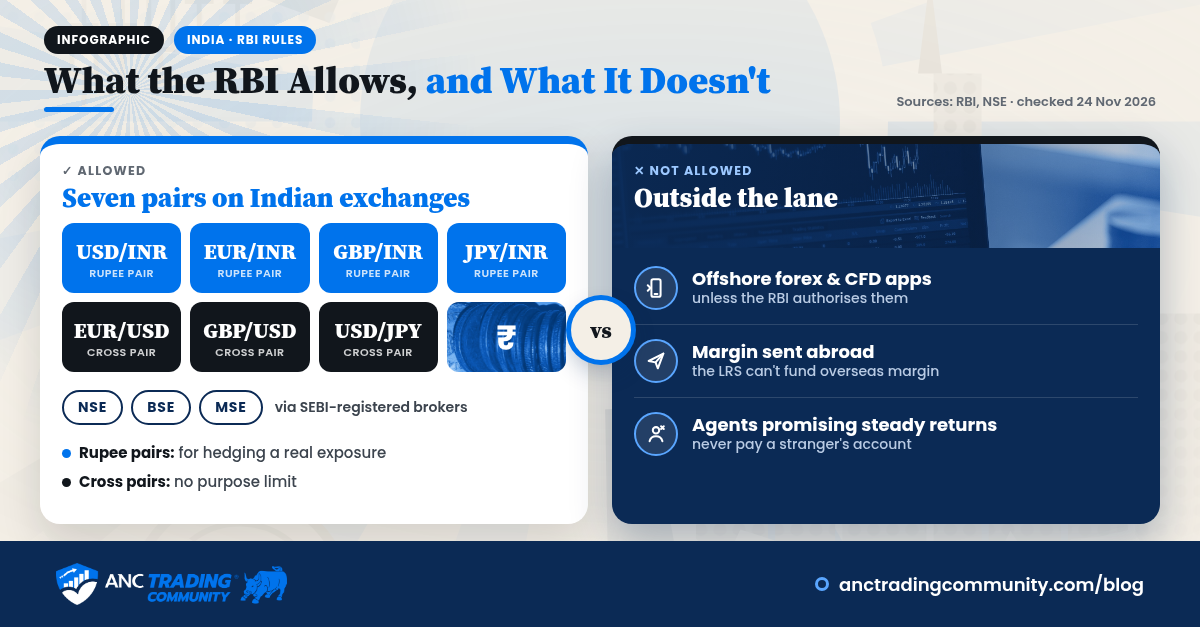
- Four rupee pairs: USD/INR, EUR/INR, GBP/INR and JPY/INR.
- Three cross pairs: EUR/USD, GBP/USD and USD/JPY, added on the NSE on 27 February 2018.
- Contract size: 1,000 units of the base currency, or 100,000 yen for JPY/INR.
- Settlement: cash, in Indian rupees, with no foreign money changing hands. Check your session times on our market hours page.
The Hedging Rule Behind the Rupee Pairs
Here is the catch most new traders miss. Under FEMA, rupee pairs on exchanges are meant for hedging a real currency exposure. In a press note on 4 April 2024, the RBI said this rule has not changed over the years. You may hold up to USD 100 million across all exchanges without showing papers. But you still need a real exposure behind the trade. Track the data that moves the rupee with our economic calendar.
By contrast, the three cross pairs carry no purpose limit, according to the RBI’s FAQs. That is why many Indian traders who want to trade EUR/USD do it on the NSE or BSE. The RBI’s updated directions took effect on 3 May 2024, a month later than planned. If you plan around news, learn how to read the economic calendar first.
What the RBI Doesn’t Allow: When Forex Trading Isn’t Legal in India
Now for the other side. Forex trading is legal in India only inside the lines above, so these moves fall outside them. Compare what each region allows on our broker comparison page:
- Offshore forex and CFD apps that are not authorised by the RBI, even if a regulator abroad licenses them.
- Sending margin abroad. The RBI’s FAQs say the Liberalised Remittance Scheme (LRS) can’t fund margin or margin calls to overseas brokers or exchanges.
- Leveraged products for retail users. At banks, the RBI’s FAQs list only plain tools for retail users, such as forwards, swaps and bought options.
- Paying agents or “account managers” who promise big, steady returns. Our guide to the best prop trading firms explains why rules matter before you pay any firm.
The LRS still lets you send up to USD 250,000 each financial year for allowed uses, such as study or travel. Trading margin is simply not one of them. In short, a foreign licence does not make forex trading legal in India on that app. Bring your questions to ANC Trading Community before you move money.
The RBI Alert List: 95 Names and Counting
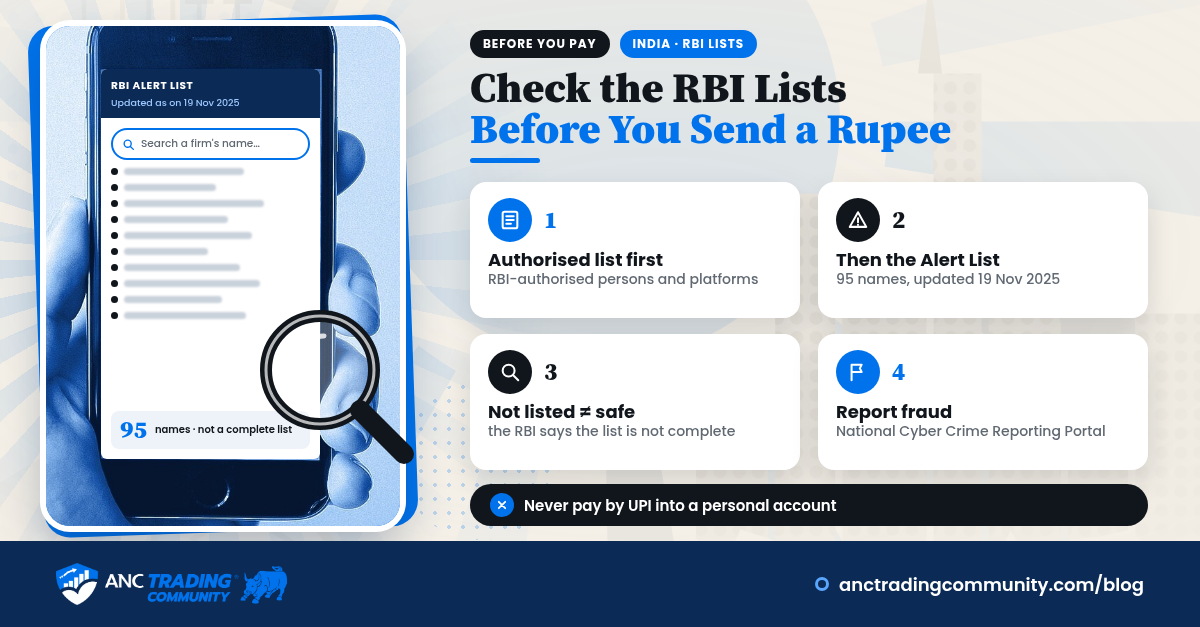
The RBI first put out its Alert List on 7 September 2022. Its latest update, dated 19 November 2025, holds 95 names. It lists firms that are neither allowed to deal in forex under FEMA nor allowed to run a trading platform. It also names sites that promote them, including some that sell training or advice. Even the MetaTrader 4 and MetaTrader 5 websites appear on it, along with some prop firms. Our MAS register guide shows the same check habit in Singapore.
However, the list is not complete. The RBI says plainly that a firm missing from it should not be assumed to be authorised. So the real test is the RBI’s list of authorised persons and authorised platforms. Is forex trading legal in India with a firm that is on neither list? No. Share any name you are unsure of with the ANC Trading Community desk.
What the ED Has Done About Illegal Forex
The Enforcement Directorate (ED) handles the money side. On 17 October 2025, it said it had attached crypto worth about Rs 2,385 crore in its case against OctaFX. In total, the ED said it had attached assets worth over Rs 2,681 crore. It also alleged that Indian investors lost about Rs 1,875 crore between July 2022 and April 2023. These are ED claims, and the case is still before a special court. Follow the story with the ANC Trading Community desk.
Two details stand out. First, the ED said funds came in through UPI and local bank transfers into dummy accounts. Second, it said the firm offered people who brought in clients hefty commissions. So if someone pushes you to pay a stranger’s account, walk away, because that is not legal forex trading in India. Then check the firm on our brokers by country page and the RBI lists.
How to Keep Your Forex Trading Legal in India
Forex trading is legal in India only with the right firm, so run this check before you pay. Then talk it through with other traders in ANC Trading Community:
- Ask whether the trade happens on the NSE, BSE or MSE, or on an RBI-authorised platform.
- Search the RBI’s list of authorised persons and platforms. No other list, not even our top broker listing, replaces it.
- Search the RBI Alert List. Even so, remember that a missing name proves nothing.
- Never pay by UPI into a personal account.
- Report fraud on the National Cyber Crime Reporting Portal, as the RBI advises.
FAQ: Is Forex Trading Legal in India?
Is forex trading legal in India?
Yes, through SEBI-registered brokers on the NSE, BSE and MSE, in the seven pairs the RBI allows. Offshore forex and CFD apps are not allowed. Learn the basics free in ANC Trading Community.
Can I trade forex with an international broker from India?
Not legally, unless the RBI authorises it. The RBI also says you can’t use the LRS to send margin abroad. See how rules differ worldwide on our brokers by country page.
Which currency pairs can I trade in India?
You can trade USD/INR, EUR/INR, GBP/INR and JPY/INR, plus EUR/USD, GBP/USD and USD/JPY. Rupee pairs need a real exposure behind them. Size your trades with our FX calculators.
What is the RBI Alert List?
It is the RBI’s list of firms and sites that are not allowed to offer forex to Indian residents. The latest update, from 19 November 2025, holds 95 names. Ask the desk in ANC Trading Community if a name looks off.
What is the penalty for illegal forex trading in India?
Under Section 13 of FEMA, a penalty can reach three times the sum involved. Where the sum can’t be worked out, it can reach Rs 2 lakh. Our guide to ESMA forex rules shows how Europe protects traders instead.
Want the desk side of this? Join ANC Trading Community free for the analysis, tools and community. Choosing where to trade? Compare regulated brokers side by side on our broker comparison page, or browse our top broker listing to find the right fit.
Risk warning: Forex, currency derivatives and CFDs are complex and come with a high risk of losing money fast due to leverage. Rules in India can change, so check the Reserve Bank of India’s own pages and your broker’s terms before you trade. This article is for information only and is not investment, legal or tax advice. ANC Trading Community is not a broker.