
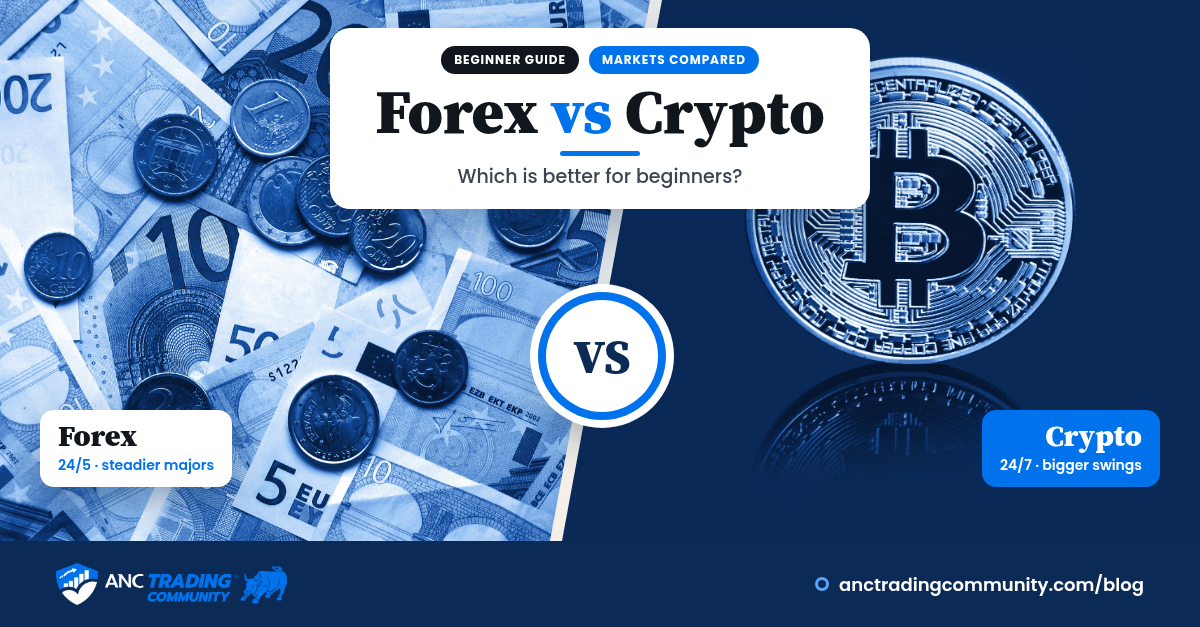

Forex vs crypto: which is better for beginners? For most people starting out, forex is the easier place to learn. The big currency pairs usually move more slowly, the market pauses at the weekend, and retail brokers in many countries work under strict leverage and client-money rules. Crypto can still work for you, but only if you’re ready for sharp swings, prices that never stop and thinner protection. That’s the honest answer we give new members of ANC Trading Community.
Below, we compare forex vs crypto on the things beginners really worry about. Those are trading hours, volatility, leverage, regulation, scams and getting your money back out. If you’d rather talk it through with other traders, join ANC Trading Community free. This is a guide, not advice, so check the rules where you live.
Forex vs Crypto: The Short Answer
Forex is the trading of one currency against another, such as EUR/USD or GBP/JPY. Crypto trading means buying and selling digital coins such as bitcoin or ether, or contracts that track their price. Both markets are open to small accounts. However, they behave very differently once real money is on the line. Our top broker listing is a good place to see what forex brokers offer.
- Forex: big, liquid pairs, a weekend break and tighter rules in many countries. See how firms stack up on our broker comparison page.
- Crypto: 24/7 prices, bigger daily moves and a patchwork of rules that still differs a lot by country.
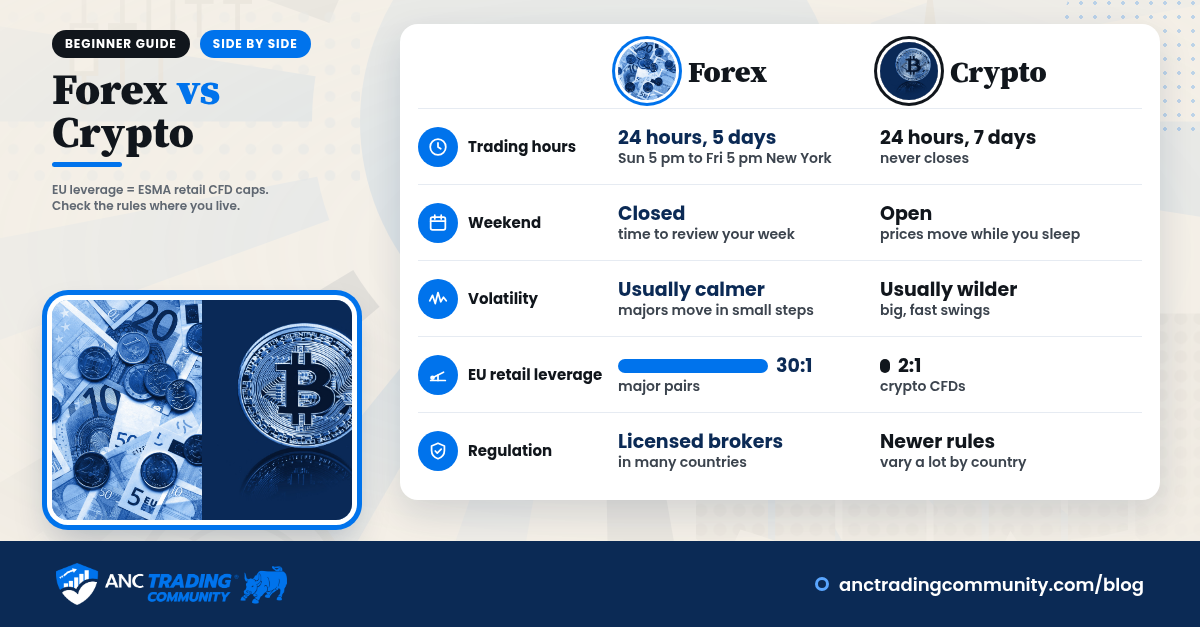
Trading Hours: 24/5 Forex vs 24/7 Crypto
The first forex vs crypto difference you’ll notice is the clock. The forex market runs around the clock on weekdays. It opens on Sunday at 5 pm New York time and closes on Friday at 5 pm New York time, passing from Sydney to Tokyo to London and New York. Check your own local times on our forex market hours page.
Crypto never closes. Coins trade on weekends, at night and on public holidays. That sounds like freedom, and for some people it is. Still, it also means your open trade can drop on a Saturday night while you’re asleep. Weekend volume is often thinner, so prices can jump on less activity. Follow live coin prices on our crypto markets page.
For a beginner, the forex weekend break is quietly useful. You get two days to review your trades, rest and plan the next week. Meanwhile, crypto traders have to choose when to switch off. Our guide on how to read the economic calendar shows how to plan a forex week around the big data releases.
Volatility: How Fast Each Market Moves
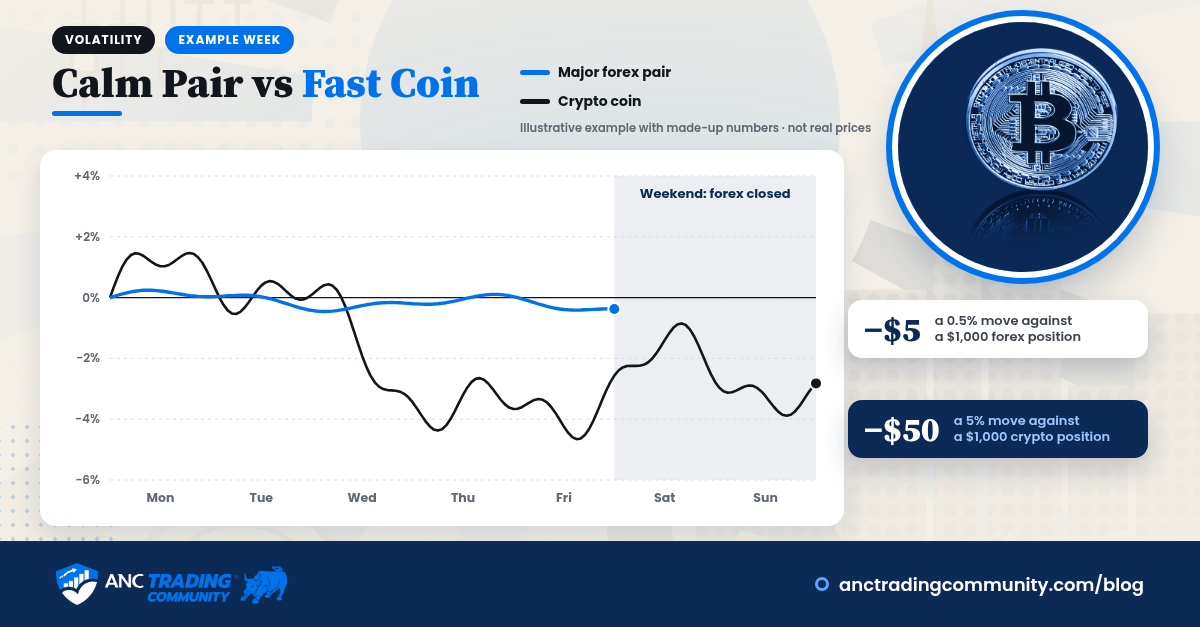
Volatility is how far and how fast a price moves. Major currency pairs tend to move in small steps, because huge banks and funds trade them all day. Crypto coins tend to move in bigger jumps, and smaller coins can move faster still. Compare how traders handle both inside our crypto community forum.
Here’s an example with made-up numbers, for the maths only. Say you hold a $1,000 position. If a currency pair moves 0.5% against you, you lose $5. If a coin moves 5% against you, you lose $50. Same position size, ten times the damage. That’s the part of forex vs crypto that catches most beginners out. Now add leverage, and that gap gets much wider. Learn how other members size trades in ANC Trading Community.
Forex vs Crypto Leverage Rules
Leverage is where the forex vs crypto gap turns into real money. It lets you control a big position with a small deposit. It works both ways, though, so it multiplies losses as fast as gains. In the EU, ESMA rules cap retail CFD leverage at 30:1 on major currency pairs but only 2:1 on cryptocurrencies. Our guide to ESMA forex rules explains the full table.
Another example with made-up numbers: with $500 of margin, 30:1 lets you open about $15,000 of EUR/USD. At 2:1, the same $500 opens only $1,000 of a crypto CFD. Regulators set the crypto limit that low because the price swings so hard. In the US, retail forex leverage is capped at 50:1 on major pairs, as our guide to the best forex brokers in the USA explains.
Be careful with offshore firms that offer 100:1 or more on crypto. A high number isn’t a gift. It’s the fastest way for a beginner to empty an account, so test any offer on our broker comparison page first.
Regulation, Scams and Withdrawals
This is where forex vs crypto differs most for beginners. In many countries, forex brokers need a licence, must keep client money apart from their own and, in the EU, must offer negative balance protection. Crypto rules are newer. The EU’s MiCA rules have applied to crypto service providers since 30 December 2024, while the UK has banned the sale of crypto derivatives to retail clients since January 2021. Find brokers your own regulator lists on our brokers by country page.
Withdrawals are the real test. When the FTX exchange collapsed in November 2022, many customers couldn’t take their money out. Crypto held on an exchange often isn’t covered by the compensation schemes that protect some broker clients, either. So check ratings and trader feedback in our crypto exchange reviews before you deposit.
Scams target both markets, but crypto attracts more of them. Watch for “account managers” who message you first, promises of fixed daily returns and platforms that ask for a fee before you can withdraw. The UK’s FCA has warned that any firm offering crypto derivatives to UK retail clients is likely to be a scam. Rules also differ a lot by country, as our guide to whether forex trading is legal in India shows.
Forex vs Crypto: Which Should You Pick First?
If you want a calmer start, begin with forex. Pick one major pair, learn how sessions and news move it, and use a demo account for a few weeks. Once you can follow a plan there, crypto becomes easier to judge. Our guide on how to trade gold for beginners uses the same step-by-step approach for XAU/USD.
On the other hand, crypto may suit you if you already hold coins and want to learn how the market works. Start with spot buying, not leverage, and keep the amount small. Our guide to spot and futures trading in crypto explains why that difference matters. Either way, the forex vs crypto choice matters less than your risk control, which we talk about every day in ANC Trading Community.
FAQ: Forex vs Crypto for Beginners
Is crypto easier than forex for beginners?
Not usually. Buying a coin is simple, but trading it well is hard because the price moves fast and never stops. Most beginners find forex easier to learn because the major pairs move more slowly. Compare forex brokers on our top broker listing.
Is crypto riskier than forex?
In a straight forex vs crypto risk comparison, crypto usually comes out riskier. Its prices tend to swing harder, and rules for crypto firms are newer in most countries. That’s why EU regulators allow only 2:1 leverage on crypto CFDs. Our guide to ESMA forex rules covers the limits.
Which is more profitable, forex or crypto?
Neither market is more profitable by itself. Bigger moves can mean bigger gains, but they also mean bigger losses. Your results depend on your plan and your risk per trade, so ask about both inside ANC Trading Community.
Can I trade forex and crypto on the same platform?
Often, yes. Many brokers offer crypto CFDs next to forex pairs on MT4 or MT5. However, a CFD isn’t the same as owning the coin, and some countries ban crypto CFDs for retail traders. Check your options on our brokers by country page.
How much money do I need to start?
You can open many forex or crypto accounts with a small deposit. Even so, start on a demo, then trade only money you can afford to lose. Before you fund anything, line up brokers on our broker comparison page.
Want the desk side of this? Join ANC Trading Community free for the analysis, tools and community. Choosing where to trade? Compare regulated brokers side by side on our broker comparison page, or browse our top broker listing to find the right fit.
Photo credits: bitcoin photograph by Tim Reckmann, Wikimedia Commons, CC BY 2.0; euro coins and banknotes photograph by Avij, Wikimedia Commons, public domain.
Risk warning: Forex, crypto and CFDs are complex and come with a high risk of losing money fast due to leverage. Crypto prices can be extremely volatile, and crypto held on exchanges may not be protected by any compensation scheme. This article is for information only and is not investment advice.