


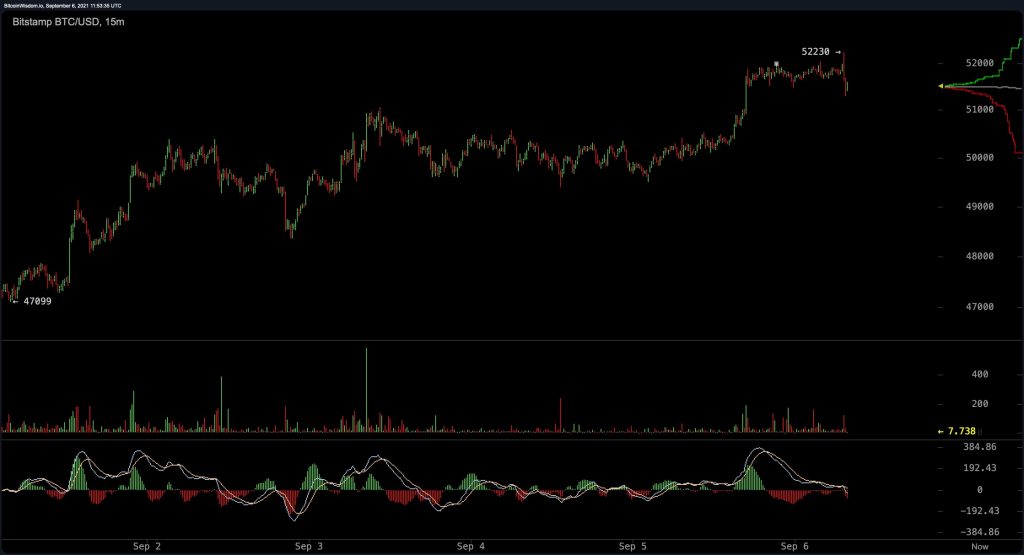
On Tuesday, the price of Bitcoin briefly rose above $52,000 on a wave of positive sentiment as the cryptocurrency formally became legal tender in El Salvador.
The Central American nation will become the first sovereign state to make Bitcoin “legal tender,” meaning it’s now an official currency alongside the US dollar. In theory, El Salvadorans can now pay for anything—a haircut, house, or even shop—using Bitcoin.
The move will make it easier for citizens of El Salvador living abroad to send money home. The new law also means every business must accept Bitcoin as legal tender for goods or services unless it is unable to provide the technology needed to do the transaction.
El Salvador’s government aims to spend up to $75 million as part of a plan to hand out $30 to people who sign up for an e-wallet called Chivo, or “Cool.” That software-based system would allow an estimated 2.5 million Salvadorans to buy goods or pay for services in U.S. dollars or Bitcoin, El Salvador’s two official currencies as of September 7, 2021.
The initiative is the brainchild of President Nayib Bukele, a 40-year-old populist whose approval rating of around 90% has emboldened him to reshape the country in his vision.
Bukele announced late Monday that his government now holds 400 Bitcoins, worth nearly $21 million at current trading levels.
Why make Bitcoin legal tender?
One-quarter of El Salvador’s GDP comes from remittances—money sent back to the country from people working abroad. Bitcoin could reduce fees on those cross-border transactions. What’s more, it will eventually facilitate the flow of remittances from expatriate workers back to the local economy.
The country’s legalization of Bitcoin as legal tender is also an attempt to bring more Salvadorans into the economic fold. For one thing, the majority of Salvadorans don’t have a bank account.
Join the ANC Trading Community & Become a Pro Trader
Still an experiment, could this backfire?
No one knows yet or what’s coming next. What’s certain, however, is that this is very much still an experiment that could backfire like any other.
El Salvador has said Bitcoin can’t be used to pay taxes, an eloquent statement as to what the government thinks of this real underlying value.
Despite all the buzz around cryptocurrency, Bitcoin hasn’t been used as an actual currency at scale before. As a business, it’s important to accept payment in a currency that won’t plummet in value in the future. Bitcoin, however, has proven to be extremely volatile.
Because Bitcoin by definition skirts traditional financial institutions that promote stability, the International Monetary Fund (IMF) is concerned that El Salvador’s adoption of the crypto could create serious risks for the country’s economy. As a result, it downgraded El Salvador’s debt further into junk territory.
The Bitcoin move, according to some critics, is a PR play to distract citizens from President Bukele’s growing despotic tactics.
Bottom line
Bitcoin’s massive volatility poses concerns. While the cryptocurrency recovered after a dramatic crash earlier this year, it remains well below its record high of nearly $65,000 set in April.
However this shakes out (and no one knows how it will), expect a lot of debate on the effectiveness of using Bitcoin as legal tender.
After briefly inching above $52,000, Bitcoin has since regressed back to the $51k range.
Join the ANC Trading Community & Become a Pro Trader