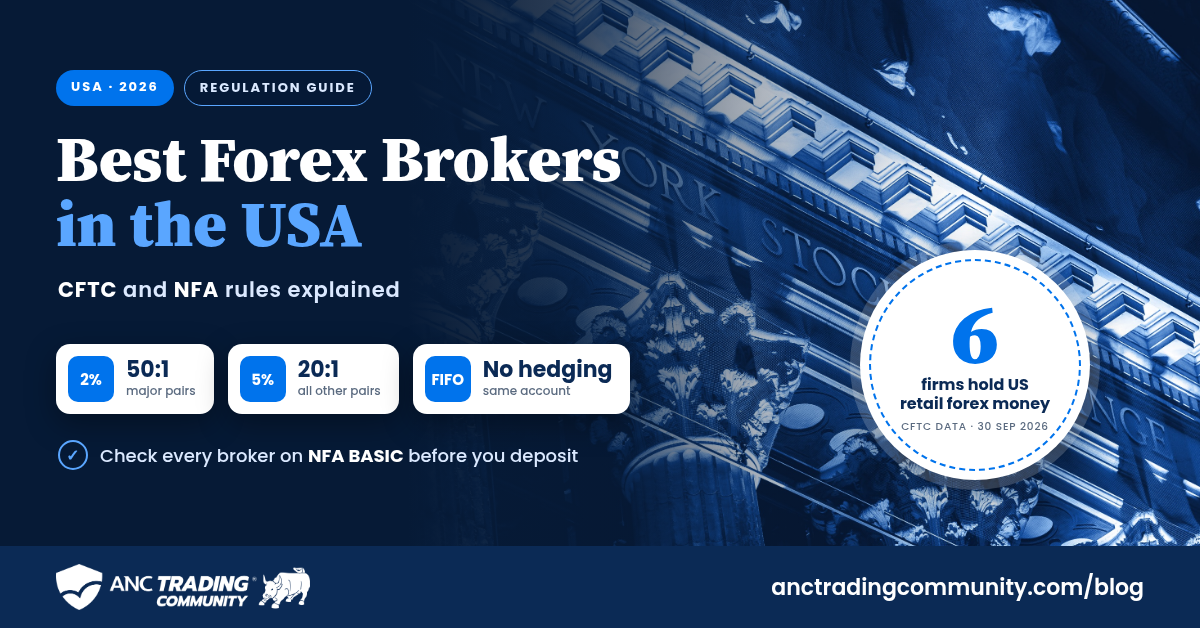

The best forex brokers in the USA are the firms registered with the CFTC and approved by the NFA as Forex Dealer Members. In 2026, only six firms hold US retail forex money, according to CFTC data. So the real question is not which broker shouts loudest. Instead, it is which firm passes the checks below, and which one fits the way you trade.
Best Forex Brokers in the USA: The Short Answer
First, only trade with a firm that shows up on NFA BASIC as an approved Forex Dealer Member. Next, accept that US rules cap your leverage and ban hedging in the same account. Then compare costs, platforms and withdrawals between the firms that pass. Finally, ignore any offshore broker that offers US clients 500:1 leverage or “no rules” accounts. Those firms are not among the best forex brokers in the USA, whatever their ads say.
As traders, we judge a broker by one thing above all: can you get your money out, quickly and in full? Regulation is the starting point for that trust, not the finish line.
Who Regulates Forex in the USA? CFTC and NFA
Two bodies share the job. The Commodity Futures Trading Commission (CFTC) is the federal regulator. It writes the rules for retail forex under the Commodity Exchange Act. The National Futures Association (NFA) is the industry’s self-regulatory body. It registers firms, audits them and runs the BASIC lookup tool.
RFED, FCM and Forex Dealer Member
A firm that acts as your counterparty in retail forex must register with the CFTC. It can register as a Retail Foreign Exchange Dealer (RFED) or as a Futures Commission Merchant (FCM). In addition, it must be an NFA member with the Forex Dealer Member status.
These firms also face strict capital rules. According to the CFTC, an RFED or forex FCM must hold at least $20 million in adjusted net capital. On top of that, it must add 5% of its retail forex obligation above $10 million.
Best Forex Brokers in the USA to Check in 2026
The CFTC publishes monthly financial data for every registered dealer. As of 30 September 2026, six firms reported money owed to retail forex customers:
- GAIN Capital Group LLC (trades as FOREX.com): about $201.0 million
- OANDA Corporation: about $134.4 million
- Charles Schwab Futures and Forex LLC: about $55.6 million
- tastyfx LLC (formerly IG US): about $49.9 million
- Interactive Brokers LLC: about $27.1 million
- Trading.com Markets Inc: about $2.5 million
These six are the starting pool for anyone looking for the best forex brokers in the USA. Still, this is a list of firms to check, not a ranking or an endorsement. Registrations change, so check each of them on NFA BASIC before you deposit. Also confirm that the legal name in your account agreement matches the name on the register.
US Leverage Caps: 50:1 and 20:1
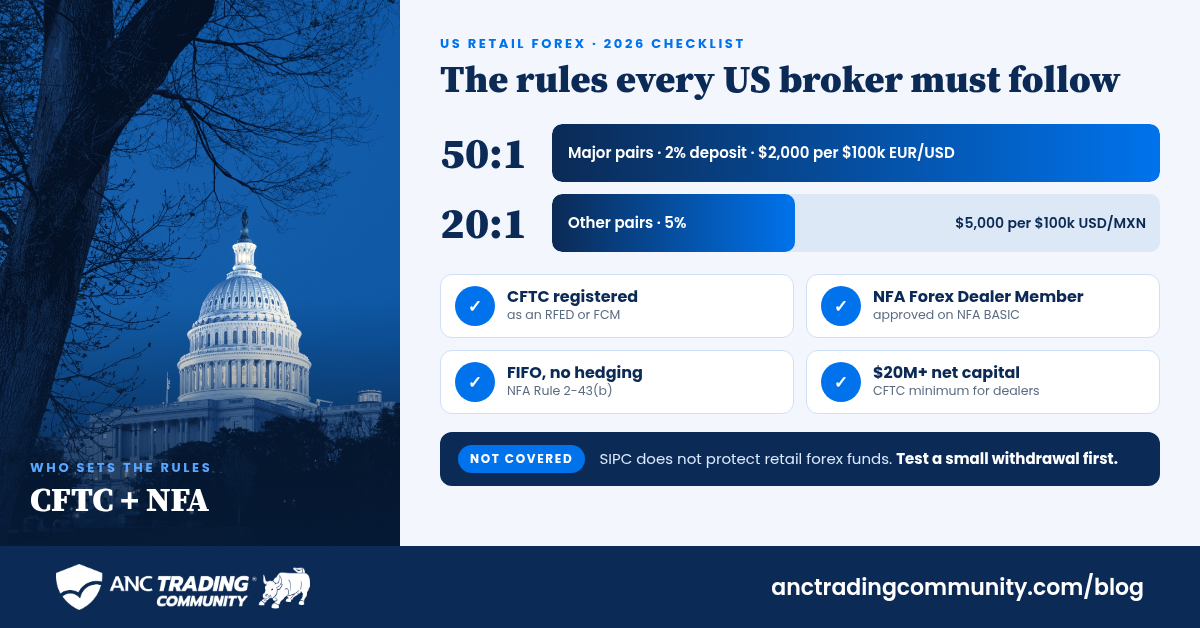
US leverage limits come from the NFA’s security deposit rules. The minimum deposit is 2% for trades in ten named currencies. They are the euro, yen, pound and Swiss franc, plus the Canadian, Australian and New Zealand dollars. The Swedish, Norwegian and Danish crowns complete the list. That equals leverage of up to 50:1. All other pairs need at least 5%, or up to 20:1.
For example, a $100,000 EUR/USD position needs at least $2,000 of margin. However, the same size in USD/MXN needs $5,000, because the higher rate applies to the whole pair. Every one of the best forex brokers in the USA must apply these limits. Brokers can also ask for more. Likewise, the NFA can raise the minimums when markets turn extreme.
Lower leverage feels like a limit. Still, it is also a safety net. A 50:1 account cannot blow up as fast as a 500:1 account. Our FX calculators show you the margin and position size before you click.
FIFO and No Hedging in the Same Account
NFA Compliance Rule 2-43(b) bans offsetting positions in one account. In other words, you cannot be long and short the same pair at the same time. Instead, the dealer closes trades first in, first out (FIFO). So the oldest trade of a given size closes first. As a result, even the best forex brokers in the USA cannot offer you a hedging account.
This matters if you run expert advisors, because many open opposite trades that US dealers must reject. Therefore, test any automated strategy on a demo account first.
What US Rules Do Not Protect
Registration is strong, but it is not a guarantee. According to the CFTC, retail forex funds are not protected by SIPC. They are also not held under the same segregation rules as futures money. If a dealer fails, forex customers may rank as unsecured creditors.
That is why withdrawals matter so much. Start small, then test a withdrawal before you add more. We cover this in depth in our guide to segregated client funds and what they really protect.
Offshore Brokers and the CFTC RED List
Many offshore brokers still market to Americans. Yet a foreign firm that solicits US retail forex clients must register with the CFTC. The CFTC keeps a Registration Deficient (RED) List of foreign firms that appear to need registration but are not registered. It added 43 names in May 2025 alone.
Also note that retail CFDs are not available to US residents. So US traders who want gold usually turn to regulated futures or ETFs, as our guide on how to trade gold for beginners explains. If a firm offers you CFDs, huge leverage or a bonus, treat it as a warning sign. Our post on red flags of fake trading platforms lists the other signs to watch.
How to Vet the Best Forex Brokers in the USA on NFA BASIC
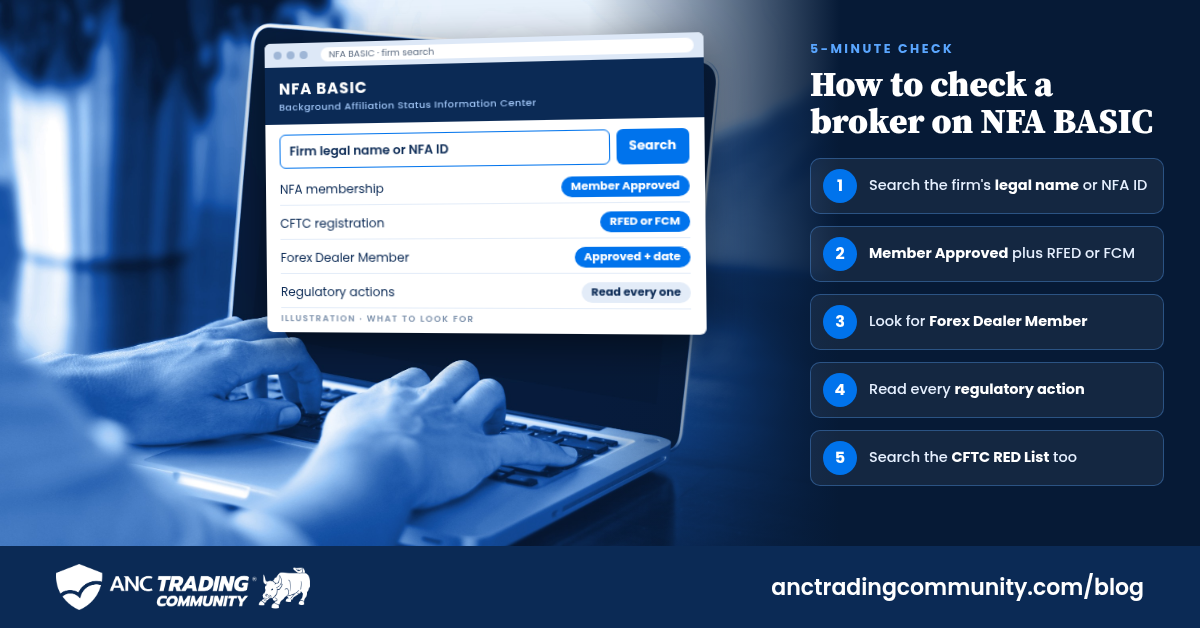
The check takes about five minutes:
- Open NFA BASIC on the NFA website and search the firm’s legal name or NFA ID.
- Confirm “NFA Member Approved” and a current CFTC registration as an RFED or FCM.
- Look for the “Forex Dealer Member” status and its approval date.
- Read every regulatory action listed, and note the dates.
- Then search the name on the CFTC RED List, and match the web address to the register.
We run this same check on any name sold as one of the best forex brokers in the USA. If any step fails, walk away. Above all, never send money to a firm you cannot find on the register.
How to Compare the Best Forex Brokers in the USA
Once a firm passes, compare it with the other best forex brokers in the USA on what costs you money. Look at spreads and trading fees on the pairs you trade. Then check overnight financing, platforms and minimum deposit. Customer service and withdrawal speed matter too, because that is where brokers win or lose trust.
It also helps to know the different types of forex brokers and how they make money. If you live outside the US, our list of regulated brokers by country shows the right rules for your market.
FAQ: Best Forex Brokers in the USA
Which are the best forex brokers in the USA?
The best forex brokers in the USA are those registered with the CFTC and approved by the NFA. In 2026, CFTC data shows six firms holding retail forex money. Check each one on NFA BASIC first.
Is forex trading legal in the US?
Yes. Forex trading is legal in the US through CFTC-registered firms that are NFA members. However, the rules cap leverage and ban hedging in one account.
What is the maximum forex leverage in the US?
It is 50:1 on the major currencies named by the NFA, and 20:1 on all other pairs. Brokers may set lower limits.
Can I hedge forex in the US?
Not in the same account. NFA Rule 2-43(b) requires FIFO and bans holding long and short positions in one pair at once.
Can Americans use offshore forex brokers?
Offshore firms that solicit US clients without CFTC registration break US rules. In addition, you may have little or no protection if something goes wrong.
Want the desk side of this? Join ANC Trading Community free for the analysis, tools and community. Choosing where to trade? Compare regulated brokers side by side on our broker comparison page, or browse our top broker listing to find the right fit.

Go Beyond the Charts, hosted by ANC Trading Community, is an exclusive FX VIP business meeting on 22 November 2026. It is free to join. So register to attend and meet leaders, brokers and serious traders in one room.
Risk warning: Forex and CFDs are complex instruments and come with a high risk of losing money rapidly due to leverage. A high percentage of retail investor accounts lose money when trading CFDs. Retail CFDs are not available to US residents. This article is for information only and is not investment advice. Not directed at residents of the EU/EEA/UK, India, Pakistan, the Philippines, Malaysia, Indonesia or Vietnam where broker promotions are restricted.
Explore more practical guides on the ANC Stock Investments blog.