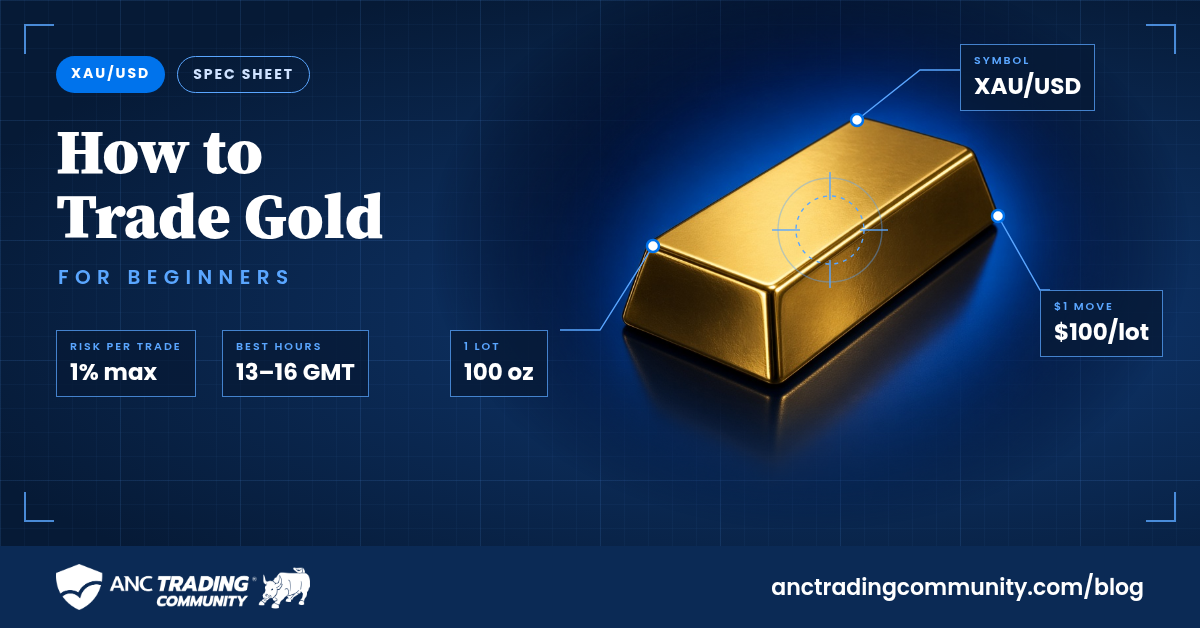

Learning how to trade gold for beginners comes down to four things: knowing what XAU/USD is, trading the right session, keeping costs low and sizing every position so one loss can’t hurt you. Gold moves fast, so the risk plan matters more than the entry. This guide walks you through each step in plain language, with the maths included.
How to Trade Gold for Beginners: The Short Answer
First, practise on a demo account until placing a stop-loss feels automatic. Next, pick one market and one session. Then risk a small, fixed share of your account on each trade, usually 1% or less. Finally, keep a journal and review it every week. Most beginners who trade gold well keep things this simple.
This week showed why the plan comes first. Spot gold had its worst week since early June, falling from $4,149 on Monday to a $3,852 low on Thursday. It then closed the week near $3,880. A beginner with too much size on that move would not get a second chance.
XAU/USD Basics: Lots, Points and Pip Value
XAU/USD is the price of one troy ounce of gold in US dollars. So a quote of 3,880.00 means one ounce costs $3,880.
At most brokers, one standard lot equals 100 ounces. That matches the size of the COMEX gold futures contract at CME Group. As a result, a $1 move in gold is worth $100 on one lot, $10 on 0.1 lot and $1 on 0.01 lot.
Brokers also define a “pip” in different ways. Some call $0.01 a pip, while others use $0.10. Because of that, beginners should think in dollars per ounce when they trade gold. Always check the contract details in your platform before you trade.
Which Gold Market Should Beginners Trade?
Beginners who trade gold from Europe, Asia, Africa, the Middle East or Latin America usually do it through a CFD on XAU/USD. You never own the metal; instead, you trade the price up or down.
In the US, however, retail CFDs are not allowed. US traders usually trade gold through regulated futures, such as micro gold (10 ounces), or through gold ETFs. Whichever route you take, use a regulated broker in your own country. Our list of regulated brokers by country is a good place to start.
Pay attention to withdrawals, too. A broker that pays out quickly and clearly earns trust. Test a small withdrawal early, before you add more money.
Spreads, Swaps and Leverage: The Real Costs
Costs matter more than beginners think, because every gold trade starts with a spread. The spread is the gap between the buy and sell price. For example, a 30-cent spread on one lot means you start $30 down. Spreads often widen at the daily rollover, around big US data and on thin holiday days.
Swap is the overnight fee for holding a position past the daily rollover. It can be a charge or, less often, a credit. Many brokers also charge three nights of swap midweek to cover the weekend. So check the swap rate before you hold a trade for days.
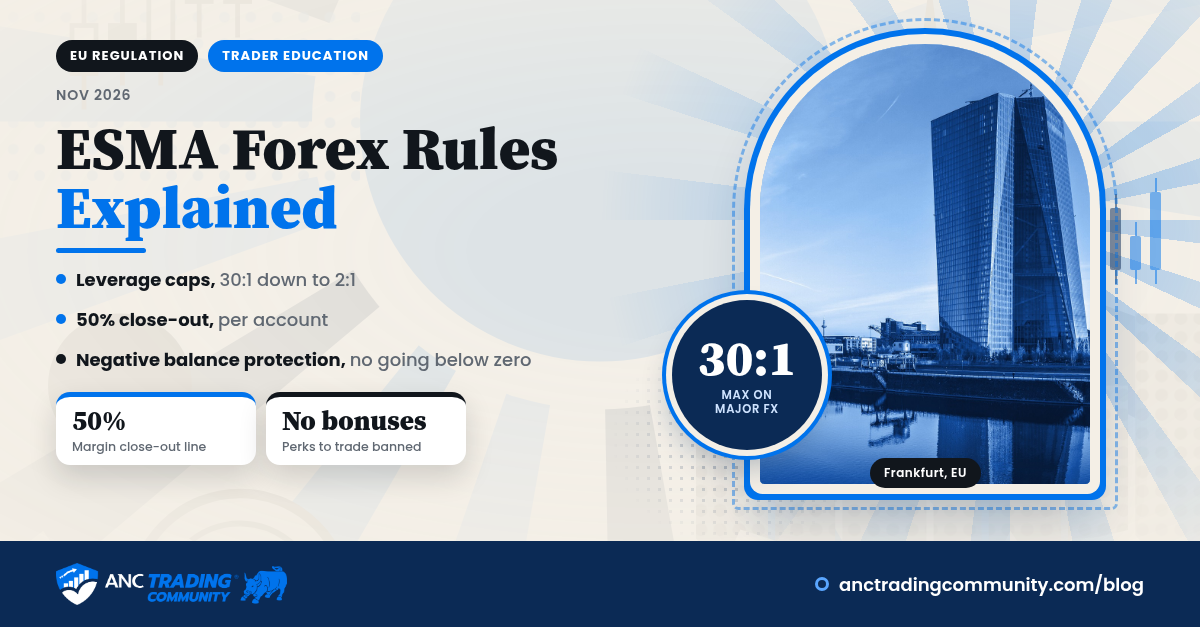
Leverage cuts both ways. In the EU, ESMA rules cap retail leverage on gold at 20:1, and the UK uses the same limit. At $3,880, one lot controls about $388,000 of gold. At 20:1 that needs roughly $19,400 in margin. One micro lot (0.01) needs only about $194, which is why beginners should start there.
When Should Beginners Trade Gold? Sessions in GMT and ET
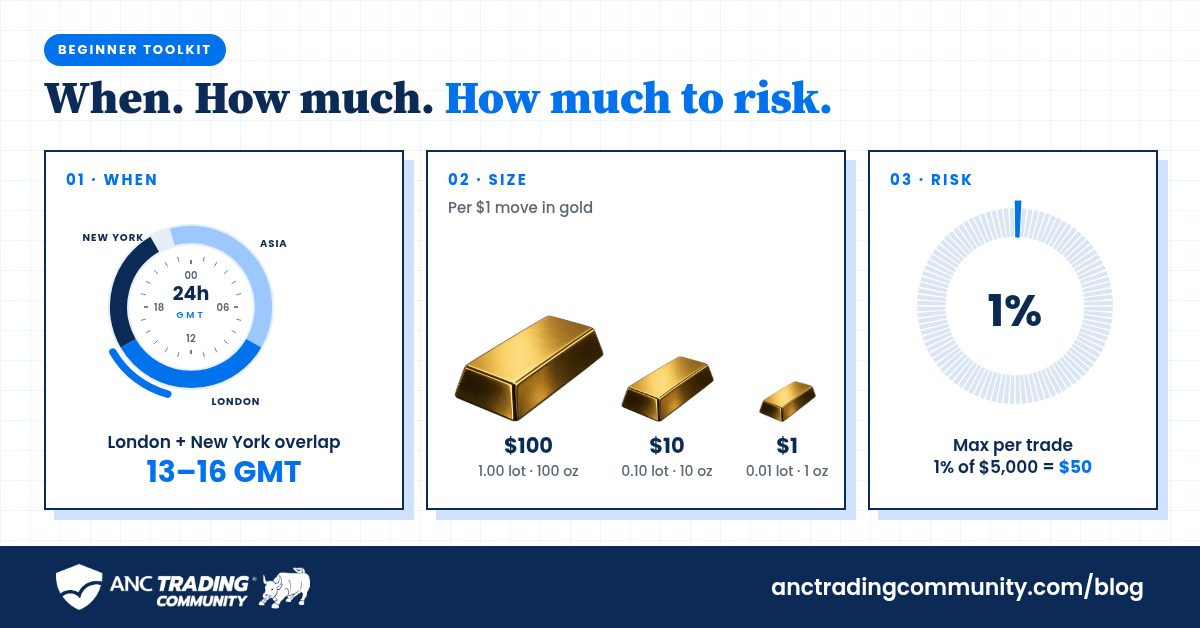
Gold trades almost 24 hours a day, five days a week. On CME Globex, it runs from Sunday 6pm to Friday 5pm ET, with a one-hour break each day at 5pm ET. Here are the main sessions in winter (November to March):
- Asia: about 23:00 to 08:00 GMT (6pm to 3am ET). Moves tend to be calmer here.
- London: about 08:00 to 16:00 GMT (3am to 11am ET). London also hosts the LBMA Gold Price benchmark auction twice a day.
- New York: about 13:00 to 22:00 GMT (8am to 5pm ET). Most big US data lands at 8:30am ET, or 13:30 GMT.
- London and New York overlap: about 13:00 to 16:00 GMT (8am to 11am ET). This is usually the busiest window.
Summer Time and Choosing Your Session
In the US and UK summer, the GMT times move one hour earlier, while the ET times stay the same. Our market hours tool shows every session in your own time zone. Above all, beginners should pick one session that fits their life and trade gold only in that window.
Position Sizing: How Beginners Should Size a Gold Trade
Position size is where most beginners win or lose the long game. The formula is simple:
Lots = money at risk ÷ (stop distance in $ × 100)
Take a $5,000 account. Risking 1% means $50. If your stop sits $10 away, you get 50 ÷ (10 × 100) = 0.05 lots. Then, if the stop hits, you lose $50 and nothing more.
Now say the market is wild and you need a $20 stop. Your size drops to 0.025 lots, so round down to 0.02. In other words, cut your size before you widen your stop. Our FX calculators do this maths for you in seconds.
Remember that a stop-loss can slip in a fast market or over a weekend gap. That is one more reason to keep risk small.
Common Mistakes When Beginners Trade Gold
These are the habits that drain accounts fastest when beginners trade gold:
- Too much size. One full lot on a small account turns a normal $10 swing into a $1,000 hit.
- No stop-loss. Hoping a trade comes back is not a plan.
- Trading the news blind. Spreads can jump in the minutes before US data, so wait for the release first.
- Revenge trading. After a loss, doubling up to win it back usually makes it worse.
- Ignoring the dollar. Gold often moves against the US dollar and real yields, so watch both.
- Trading every session. Tired traders make poor choices, especially late at night.
A Simple Gold Trading Plan for Your First Month
Start with two weeks on a demo account. Then, follow these steps on a small live account:
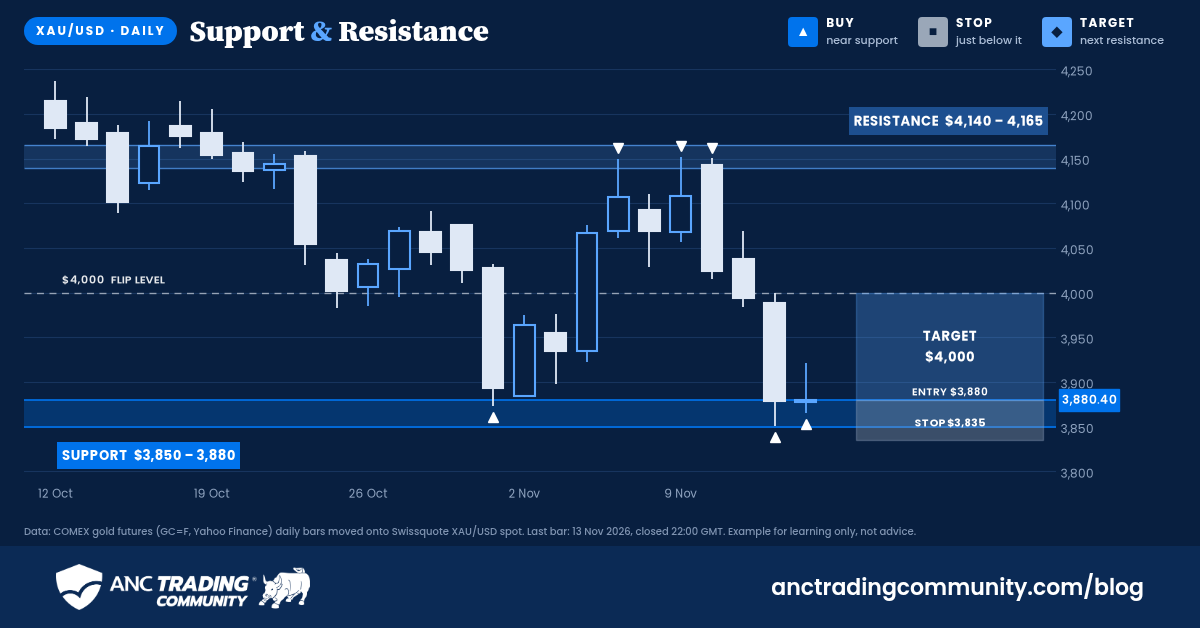
- Mark key levels on the 4-hour and 1-hour charts before your session opens.
- Check the calendar for US data such as CPI, jobs and Fed meetings.
- Write your entry, stop and target before you click.
- Risk 1% or less, and stop for the day after two losses.
- Log every trade with a screenshot and one lesson.
After a month, review your journal. Keep what works, and drop what doesn’t. This plan keeps beginners who trade gold focused on process, not profit. For ideas on live setups, follow our gold signals and read how to trade and invest in gold effectively.
FAQ: How to Trade Gold for Beginners
Is gold trading good for beginners?
It can be, because gold is liquid and reacts to clear drivers. However, it moves fast. So beginners should trade gold with micro lots, a stop-loss and a written plan.
How much money do I need to trade gold?
There is no fixed amount. Still, with 0.01 lot and a $10 stop you risk $10 a trade. Following a 1% rule, that suits an account of about $1,000.
What is 1 lot of gold?
At most brokers, one standard lot of XAU/USD is 100 ounces. So each $1 move equals $100 of profit or loss.
Is gold trading open 24 hours or on weekends?
Gold trades nearly 24 hours from Monday to Friday, with a short daily break. It closes at the weekend, so prices can gap at the Sunday open.
What is the best time to trade gold?
For most traders, the London and New York overlap from about 13:00 to 16:00 GMT (8am to 11am ET) brings the most movement.
Want the desk side of this? Join ANC Trading Community free for the analysis, tools and community. Choosing where to trade? Compare regulated brokers side by side on our broker comparison page, or browse our top broker listing to find the right fit.

Go Beyond the Charts, hosted by ANC Trading Community, is an exclusive FX VIP business meeting on 22 November 2026. It is free to join. So register to attend and meet leaders, brokers and serious traders in one room.
Risk warning: CFDs are complex instruments and come with a high risk of losing money rapidly due to leverage. A high percentage of retail investor accounts lose money when trading CFDs. This article is for information only and is not investment advice. Not directed at residents of the EU/EEA/UK, India, Pakistan, the Philippines, Malaysia, Indonesia or Vietnam where broker promotions are restricted.
Explore more practical guides on the ANC Stock Investments blog.