

Blockchain technology can play a key role in the development of Central Bank Digital Currency (CBDC) platforms worldwide, according to a joint research project by Estonian Central Bank Eesti Pank and leading European deep tech company Guardtime.
The study set out to investigate the technological and operational frontiers of blockchain technology and its use in the context of CBDCs using KSI Cash, a digital currency technology based on the KSI Blockchain.

Testing confirmed that digital bill-based money systems are linearly scalable and highly efficient delivering end-to-end payment times of 0.6 seconds based on speeds of up to two million bill transactions per second.
Crucially, it delivered a much smaller carbon footprint and lower energy use than current instant payments platforms – per transaction energy was just 70 µWh (micro-Watt -hour), compared with 0.1 Wh (Watt hour) for Visa and 1 MWh (Megawatt hour) for Bitcoin (1 Megawatt hour is one trillion micro-Watt hours).
The summary report written by Rainer Olt and Tiit Meidla of Eesti Pank and Luukas Ilves and Jamie Steiner of Guardtime says:
“The CBDC platform we deployed proved to perform well. The system was tested at speeds of up to two million bill transactions per second, where it operated with faster transaction times, lower energy use, and a smaller carbon footprint than current instant payment platforms.”
Central banks catching on blockchain technology
Central banks worldwide are considering the introduction of both retail and wholesale CBDCs with countries including China with the e-Yuan and the Bahamas with the Sand Dollar launching or making retail versions widely available.
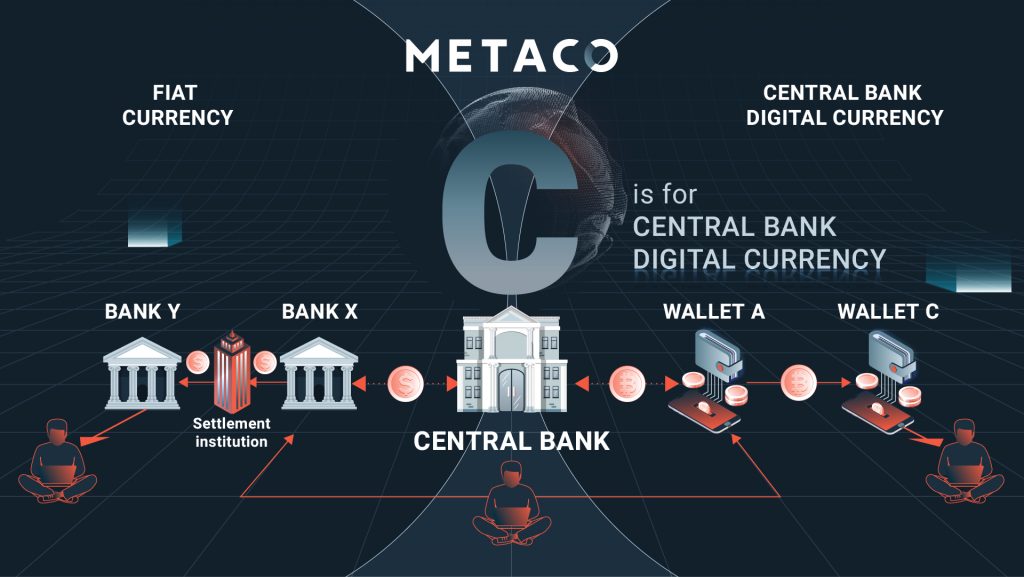
The European Central Bank had decided to proceed with more intense investigations into a retail digital Euro while the Bank of International Settlements says 86% of Central banks are conducting research or pilot schemes.
Eesti Pank and Guardtime’s research demonstrated its CBDC platform can integrate with existing e-ID schemes, making Know Your Customer checks easier and onboarding users into the system.
Privacy-preserving architectures can be made compatible with analytics needed for anti-money laundering monitoring.
Digital bills provide the privacy and programmability benefits of tokens but can also be held in account-like wallets, while the custodial layer used in the test enabled compatibility with conventional payment infrastructures.
KSI Cash’s security model delivers cryptographic verifiability of system operations without compromising privacy and the system proved to be resilient and resistant to insider and outsider attacks. It also provides resistance to quantum attacks.
The project measured resource load during testing and an indirect assessment of the carbon footprint of the system showed emissions of 32 tonnes of CO2 per year, assuming a 14kW power requirement.
Energy needs of one bill payment were estimated at 0.000000070 kWh (70 microwatt-hours) which is equivalent to 0.000016 g of CO 2 (16 micrograms). The table below shows the comparable figures for Visa and major cryptocurrencies.
| Bitcoin | Ethereum | Visa | Algorand | KSI Cash |
| 1 MWh | 170kWh | 0.1Wh | 36 mWh | 7 μWh |
Table. Comparison of per transaction energy use (given in Wh per transaction. 1 MWh =1,000,000,000,000 µWh)
About Guardtime
Guardtime, Europe’s leading deep tech company, was founded in Tallinn, Estonia in 2007 by a team of cryptographers and computer scientists. The initial goal was to support the Estonian Government to design and build a system that would allow information to be validated without centralized trust authorities.
Their invention, KSI, replaces trust with digital truth – formally verifiable mathematical proof of the integrity of data, networks, systems, and processes, without the reliance on keys, secrets, or centralized trust authorities.
KSI technology enables applications to be built with truth inherent in their design, delivering value wherever there is digital.
About Eesti Pank
Eesti Pank (Bank of Estonia) is the central bank of Estonia as well as a member of the Eurosystem organization of euro area central banks. The Bank of Estonia also belongs to the European System of Central Banks.